
For two decades, the farnesoid X receptor (FXR) has been one of the most pursued — and most disappointing — targets in liver disease. More than twenty FXR agonists have entered clinical trials since the early 2000s, chasing a simple logic: bile acids activate FXR, FXR regulates bile acid balance, and restoring that balance should treat the metabolic liver diseases that follow when it fails. Almost none of those drugs made it to approval. Obeticholic acid, the one that did, was approved in 2016 for primary biliary cholangitis and then withdrawn from the European market in 2024, having never received full FDA approval for broader use.
A new paper in Nature argues that the field has been getting something basic wrong: not which receptor to hit, but when, and for how long.
A receptor built to pulse, not stay on
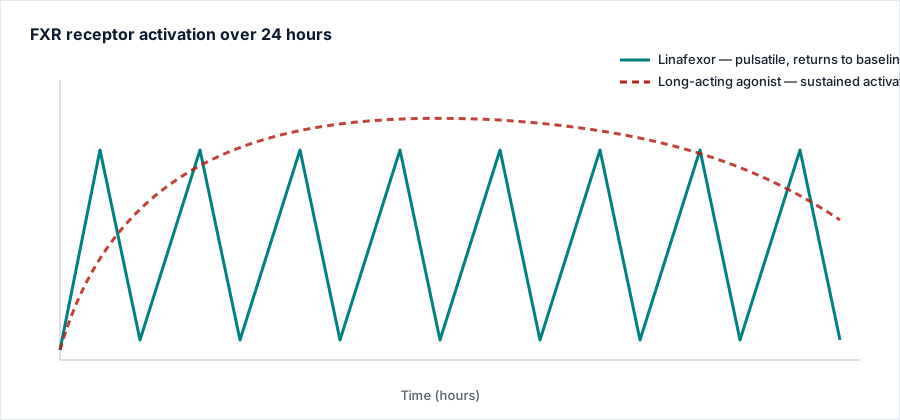
Natural bile acids are short-lived signalling molecules. They surge after a meal, activate FXR for a window of roughly ten minutes to an hour, and then clear, allowing the receptor to reset before the next meal triggers another pulse. Every synthetic FXR agonist that has reached clinical trials, by contrast, was engineered the opposite way — for long half-lives and sustained exposure, the conventional goal for an oral once-daily drug.
Researchers at the Shanghai Institute of Materia Medica, together with collaborators at Cascade Pharmaceuticals and Xiamen University, designed a compound meant to break that pattern. Linafexor (also known as CS0159) is built around a 1,2,4-oxadiazole-5(4H)-one ring in place of the carboxylic acid group found in most FXR ligands, with a cyclic ester incorporated specifically to make the molecule metabolically unstable — engineered, in other words, to be broken down quickly rather than to resist it.
The strategy worked. In biochemical assays, linafexor bound FXR with an EC50 of 3.78 nM, outperforming the clinical-stage agonist tropifexor (9.62 nM) and obeticholic acid by roughly 150-fold (629 nM). In cell-based transcriptional activation assays, linafexor and tropifexor were roughly equivalent (0.35 nM and 0.37 nM respectively), both around 800 times more potent than obeticholic acid. But the more telling numbers came from pharmacokinetics: linafexor’s half-life stayed under one hour across rat, dog, monkey and human liver microsomes, chiefly through metabolism by CYP3A4 — compared with 14 to 22 hours for tropifexor and roughly 24 hours for obeticholic acid.
What the crystal structure shows
To understand how such a structurally distinct molecule achieves potency comparable to tropifexor, the team solved the crystal structure of the FXR ligand-binding domain bound to linafexor and a coactivator peptide (SRC2-2), at 2.8 Å resolution. The structure — deposited in the Protein Data Bank as entry 9LQ3 — shows linafexor occupying the ligand-binding pocket in a pose nearly superimposable on tropifexor (root-mean-square deviation of 0.59 Å), engaging the same network of hydrogen bonds and hydrophobic contacts that stabilise the receptor’s active, coactivator-binding conformation.
The viewer below renders the deposited coordinates directly — the same structure referenced above, not a redrawn illustration. Drag to rotate; use the buttons to toggle the binding-pocket surface or auto-spin.
Loading 3D structure…
Why duration, not just dose, decides toxicity
The paper’s most striking experiment has nothing to do with linafexor’s chemistry at all. To isolate the effect of timing from the effect of the compound itself, the researchers delivered linafexor continuously, via an osmotic pump, instead of as a daily pulse. The result was severe systemic toxicity requiring early termination of the experiment — from the identical molecule that had been well tolerated as a once-daily dose. Administering the same total exposure on an every-other-day schedule at double the dose also sharply reduced efficacy compared with daily pulsatile dosing, despite higher peak drug levels.
Transcriptomic analysis offered a mechanistic explanation. After a single dose, linafexor altered the expression of 303 genes at its peak (4 hours), with most returning to baseline by 24 hours. Tropifexor, dosed acutely, altered more than six times as many genes (1,916) at its own peak and kept many of them dysregulated through the full 24-hour window. In four-week chronic-dosing studies, tropifexor’s sustained activation reduced FXR expression by roughly 70% and completely suppressed two downstream bile-acid synthesis enzymes (CYP7A1 and CYP8B1) — a pattern the authors describe as receptor desensitisation, structurally analogous to insulin resistance from chronic insulin exposure. Linafexor’s downstream targets, including SHP, MAFG, CYP7A1 and CYP8B1, moved and then reverted to baseline within the same daily window, preserving what the authors call “cyclic FXR signalling.”
From mouse models to a first-in-human dose
Across disease models, linafexor produced dose-dependent improvements that the authors report as superior to obeticholic acid at comparable or lower exposures:
- In a diet-induced mouse model of metabolic dysfunction-associated steatohepatitis (MASH), linafexor reduced hepatic triglycerides, liver cholesterol, serum LDL-cholesterol and hydroxyproline (a fibrosis marker), with near-complete resolution of steatosis at the highest dose tested (1 mg/kg).
- In a diet-induced rat model of liver fibrosis, linafexor reduced Sirius-red-positive fibrotic area, with sustained anti-fibrotic activity through 24 weeks of disease progression.
- In chemically induced mouse models of primary biliary cholangitis and primary sclerosing cholangitis, linafexor outperformed ursodeoxycholic acid, obeticholic acid, tropifexor and cilofexor on serum markers of cholestatic injury (alkaline phosphatase, bilirubin, transaminases and total bile acids).
A phase 1 trial in the United States (ClinicalTrials.gov, NCT05082779) — a double-blind, placebo-controlled study spanning six single-ascending-dose cohorts (0.2–8.0 mg) and four multiple-ascending-dose cohorts (0.4–4.0 mg over two weeks) — reported transient, once-daily FXR pathway engagement: induction of FGF19, the endocrine mediator of bile acid feedback, and suppression of C4, a marker of hepatic bile acid synthesis, with no treatment-related adverse events reported.
The open question
The dosing experiments in this paper are a relatively rare thing in pharmacology: a direct, controlled test of a hypothesis about why a whole drug class has failed, rather than only a report that a new molecule works. If pulsatile activation turns out to be the operative variable — not linafexor’s particular chemotype — it reframes FXR as a target that failed not because it was undruggable, but because it was dosed against its own biology. Confirming that will fall to the phase 3 programme in MASH, primary biliary cholangitis and primary sclerosing cholangitis that this data is intended to support.