Semaglutide and tirzepatide have reshaped the metabolic disease market as injectables, but the needle remains a real barrier to uptake for a meaningful fraction of patients who would otherwise be candidates. An effective oral GLP-1 receptor agonist has been a declared goal across the industry for years, complicated by two compounding problems: peptides are degraded by gastric and pancreatic proteases before they can be absorbed, and even an intact peptide is usually too large and too polar to cross the intestinal epithelium in any meaningful quantity.
Oral semaglutide (marketed as Rybelsus) addressed this partially, using a small-molecule absorption enhancer (SNAC) co-formulated with the peptide, but requires a strict fasting dosing regimen and achieves substantially lower bioavailability — and correspondingly more modest weight-loss effects — than the injectable form. Isthmus Biosciences, a clinical-stage company based in San Diego, reports Phase 2 data this week for ISX-220, an oral GLP-1 program it says narrows that gap considerably, through a different absorption strategy.
A door that opens and closes
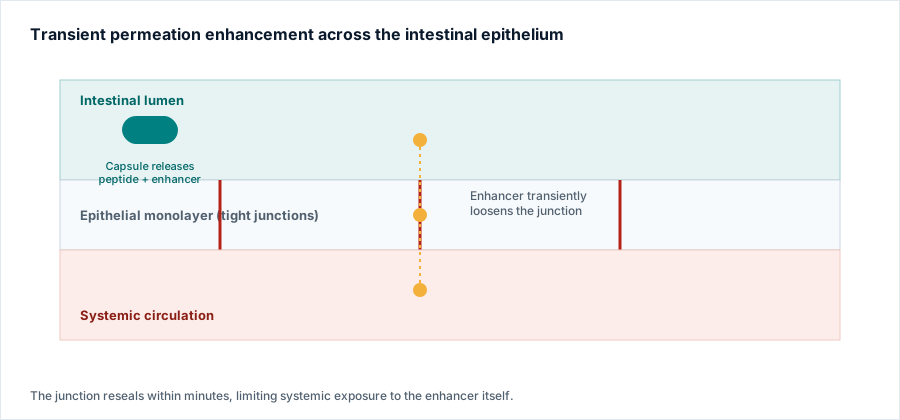
Rather than modifying the peptide to resist degradation or passively diffuse across the gut wall, ISX-220 is co-formulated with a synthetic medium-chain fatty-acid derivative engineered to transiently and reversibly loosen the tight junctions between intestinal epithelial cells — the structures that normally seal the paracellular space between cells and block large or polar molecules from passing through.
“The design goal was a junction that opens for a window of a few minutes, long enough for a bolus of peptide to cross paracellularly, and then closes again before anything else — bacterial products, antigens, whatever else is in the lumen — gets an opportunity to follow,” said Dr. Samuel Petrov, Isthmus’s chief scientific officer. In preclinical pharmacology studies cited in the Phase 2 publication, intestinal transepithelial electrical resistance (a standard measure of junction integrity) returned to within 90% of baseline within 20 minutes of enhancer exposure in an ex vivo porcine ileum model.
Phase 2 results
The 36-week, randomized, double-blind, placebo-controlled Phase 2 trial enrolled 412 adults with obesity (BMI ≥30) or overweight with at least one weight-related comorbidity, across four once-daily oral dose arms (2 mg, 5 mg, 10 mg, 15 mg) plus placebo. The trial’s primary endpoint was percent change in body weight from baseline at week 36.
- The 15 mg arm achieved a mean weight reduction of 13.2% from baseline, compared with 2.1% for placebo.
- Absolute bioavailability, assessed in a satellite pharmacokinetic sub-study, averaged 11.4% — roughly double the bioavailability reported in public data for SNAC-based oral semaglutide at comparable doses, though the authors caution that cross-trial comparisons of bioavailability are sensitive to assay and dosing-condition differences.
- Gastrointestinal adverse events (nausea, diarrhea, constipation) occurred at rates broadly consistent with the injectable GLP-1 class, and were the most common reason for discontinuation (7.8% across active arms, versus 1.9% on placebo).
- No signal of increased intestinal permeability to unrelated luminal contents (assessed via a lactulose–mannitol urinary excretion test, a standard gut-barrier integrity assay) was observed at any dose relative to placebo, which the authors present as reassurance against the theoretical concern that a permeation enhancer could non-specifically compromise gut barrier function.
What’s still open
A 36-week Phase 2 trial does not resolve the question that matters most for a mechanism built around deliberately perturbing gut barrier integrity, even transiently: what happens with chronic, years-long daily use, in the much larger and more heterogeneous population a Phase 3 program and eventual real-world use would involve. The lactulose–mannitol data in this trial are reassuring at 36 weeks; they are not a substitute for longer follow-up, nor do they fully address lower-frequency safety signals that a trial of 412 patients is underpowered to detect — the kind of rare adverse events that have occasionally emerged only after an absorption-enhancer mechanism reaches tens of thousands of patients.
Isthmus says it has started enrollment for a 68-week Phase 3 program with an active safety extension, with topline data expected in late 2028. Whether an oral option that still requires fasting-adjacent dosing conditions and once-daily administration meaningfully shifts the injectable-dominated GLP-1 market — or simply adds another option within it — is a commercial question the Phase 3 data will not settle on its own.