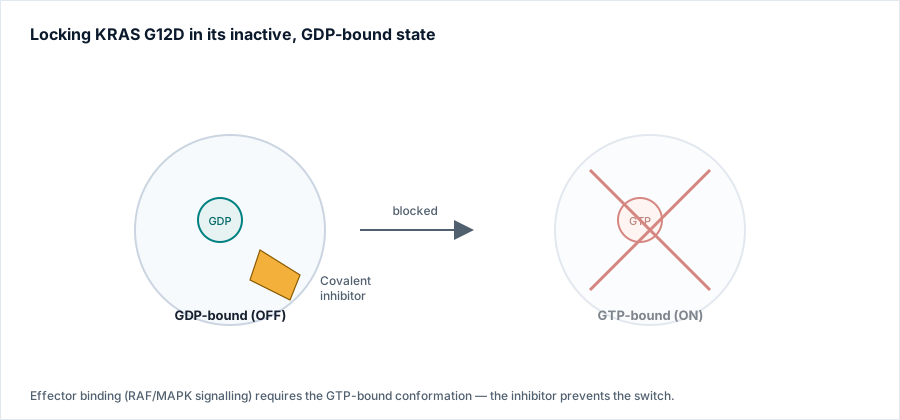
KRAS has a reputation problem. For thirty years after its discovery as an oncogene, it was described in textbooks as “undruggable” — a smooth, featureless protein surface with no obvious pocket for a small molecule to grab onto. That changed in 2021 with the approval of sotorasib, a covalent inhibitor of the G12C mutant, which exploits a shallow groove (the switch-II pocket) that only opens transiently as the protein cycles between active and inactive states.
G12C accounts for roughly 14% of KRAS-mutant cancers, concentrated in lung adenocarcinoma. G12D — common in pancreatic and colorectal cancer — lacks the reactive cysteine that G12C inhibitors depend on, and has proven considerably harder to drug covalently. Aldebaran Therapeutics, a Boston-based computational drug discovery company, says its lead candidate, ALD-9102, closes that gap, and that the way it was found is as notable as the molecule itself.
Sampling a pocket instead of screening a library
Conventional fragment-based drug discovery starts with a physical or virtual library — tens of thousands to billions of candidate fragments — and screens for binding, usually by soaking fragments into protein crystals or running high-throughput biochemical assays. Aldebaran’s team instead trained a structure-conditioned diffusion model on a dataset of roughly 40,000 solved protein–ligand complexes, then conditioned generation specifically on the geometry of the KRAS G12D switch-II pocket, including the aspartate side chain the mutation introduces.
“We’re not retrieving a molecule that already exists in some database,” said Dr. Elena Choi, Aldebaran’s head of computational chemistry, in a briefing ahead of the paper’s publication. “The model is sampling directly from the space of molecules it predicts will satisfy that pocket’s shape and electrostatics — including an electrophile positioned to reach the mutant aspartate.”
The published pipeline generated roughly 1.2 million candidate structures in silico, filtered them through a cascade of a physics-based docking re-score, a synthetic-accessibility classifier, and predicted ADMET (absorption, distribution, metabolism, excretion, toxicity) properties, before narrowing to 86 candidates for actual synthesis. Of those, 19 showed measurable binding in a biochemical assay; ALD-9102 was the most potent, with a measured IC50 of 4.1 nM against KRAS G12D in a nucleotide-exchange assay — roughly comparable to the potency reported for early G12C-selective tool compounds against their own target.
What the crystal structure confirmed — and what it didn’t
A co-crystal structure of KRAS G12D bound to ALD-9102, solved at 1.9 Å resolution, confirmed that the compound occupies the switch-II pocket largely as the model predicted, with the designed electrophile positioned within covalent bonding distance of the mutant aspartate side chain. The overall binding pose matched the model’s top-ranked prediction with a heavy-atom RMSD of 1.3 Å — close enough, the authors argue, to validate the geometric reasoning behind the design, though not so close as to make the docking step redundant.
Two specific predictions from the model did not hold up experimentally. A predicted intramolecular hydrogen bond meant to pre-organise the molecule’s reactive warhead was not observed in the solved structure, and a second-generation analogue the model ranked as more potent than ALD-9102 itself turned out, on synthesis, to be roughly four-fold less potent in the biochemical assay. The authors are candid about this in the paper, framing it as a reminder that generative structure prediction narrows a search space — it does not yet replace the assay.
Fourteen months, not the usual four to six years
Aldebaran reports that the interval from the first model-generated candidate structure to Phase 1 dosing of the first patient was fourteen months — against an industry-typical four-to-six-year preclinical timeline for a novel covalent inhibitor program, by the authors’ own benchmarking against comparable public disclosures. Independent oncologists contacted for comment were measured about how much of that acceleration to credit to the generative design step specifically, as opposed to Aldebaran’s existing covalent-chemistry synthesis infrastructure and a regulatory environment now familiar with the KRAS mechanism class following sotorasib and adagrasib.
“The hard part was never really the design phase, even before AI — it was manufacturing, tox packages, and trial logistics,” said one reviewer not involved with the study, speaking on background. “Compressing the hit-finding step from eighteen months to six weeks is real and valuable. It’s not the same claim as compressing the whole fourteen-year drug development timeline.”
The ongoing Phase 1 trial (dose escalation, single agent, in advanced pancreatic ductal adenocarcinoma and KRAS G12D-mutant colorectal cancer) is enrolling across eight sites in the United States, with initial safety and pharmacokinetic data expected in the first half of 2027.